
Immunization Services
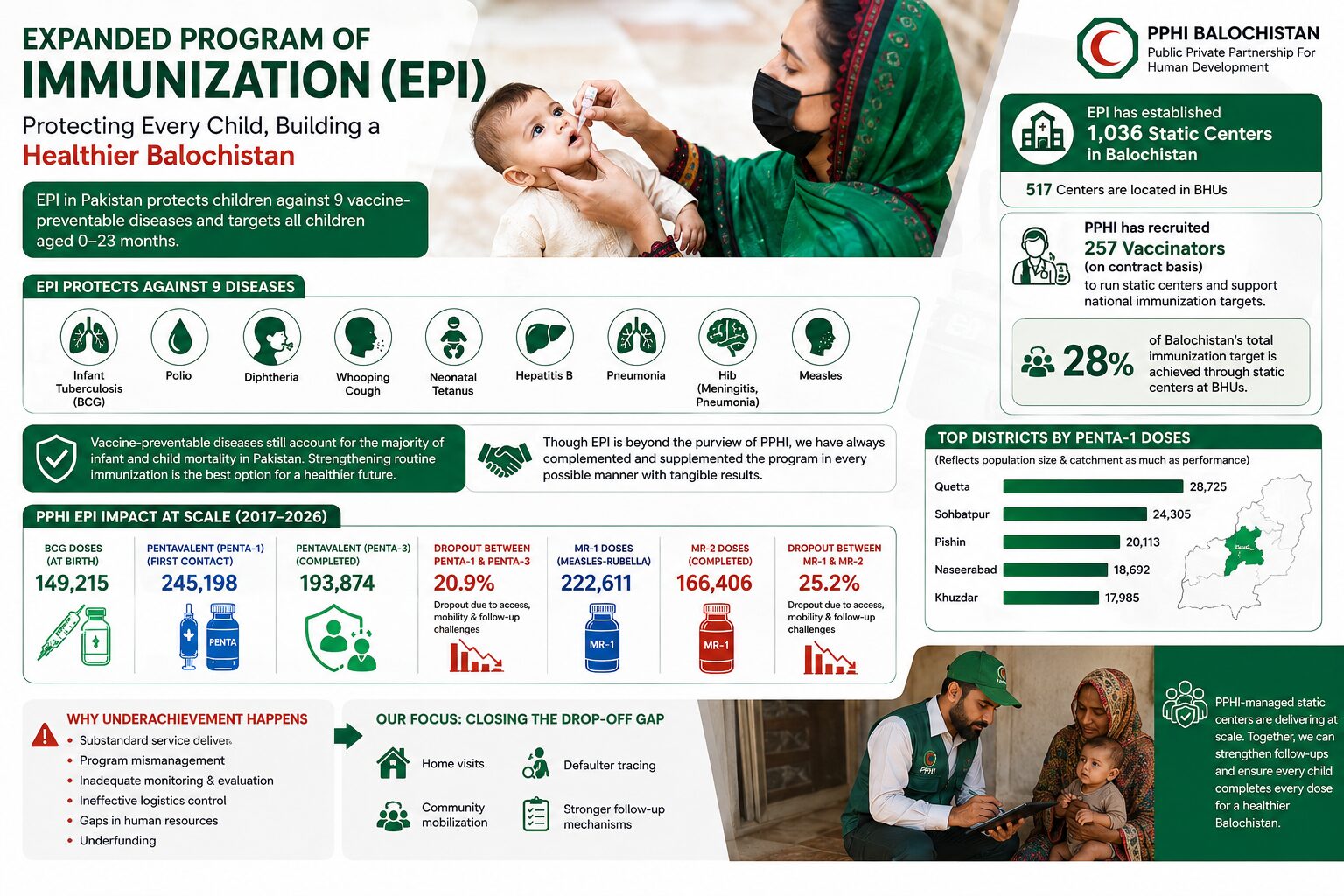
The Expanded Program of Immunization (EPI) in Pakistan protects the population against nine diseases preventable by vaccines — infant tuberculosis, poliomyelitis, diphtheria, whooping cough, neonatal tetanus, hepatitis B, pneumonia, hemophilus influenza B (causes meningitis, pneumonia), and measles. The immunization program targets all children between the ages of 0–23 months. Unfortunately, vaccine-preventable diseases still account for the majority of infant and child mortality in Pakistan.
Evidence suggests that underachievement in immunization is due to a combination of factors, which include substandard service delivery, program mismanagement, inadequate monitoring and evaluation, ineffective logistics control, gaps in human resources, and underfunding. In this scenario, the best option for the government is to strengthen the health system by improving routine immunization.
Although EPI is beyond the purview of PPHI, we have always complemented and supplemented the immunization program in every possible manner and shown tangible results. The EPI has established 1,036 static centers in Balochistan, out of which 517 are located in BHUs. To put immunization services on track, PPHI has recruited, on a contract basis, 257 vaccinators who run the static centers to achieve national immunization targets. It is noteworthy that 28% of Balochistan’s total immunization target is achieved through static centers at BHUs.
This is borne out at scale in PPHI’s own EPI records. Cumulative doses delivered at PPHI-managed static centers across Balochistan’s 39 districts (2017–2026) total roughly 149,215 BCG doses and 245,198 Pentavalent (Penta-1) doses administered at first contact. However, only about 193,874 children went on to complete Pentavalent Dose 3, reflecting a dropout rate of approximately 20.9% between the first and third contact — a gap consistent with the access, mobility, and follow-up challenges typical of Balochistan’s dispersed rural population. A similar pattern holds for measles-rubella coverage, where MR-1 doses (222,611) fall to MR-2 doses (166,406), a dropout of about 25.2%. Quetta, Sohbatpur, Pishin, Naseerabad, and Khuzdar account for the largest volumes of Penta-1 doses among all districts, though this reflects population size and catchment as much as performance. These figures underline both the scale of what PPHI-managed static centers are already delivering and the continued need to strengthen follow-up mechanisms — home visits, defaulter tracing, and community mobilization — to close the drop-off between first and completed doses.