
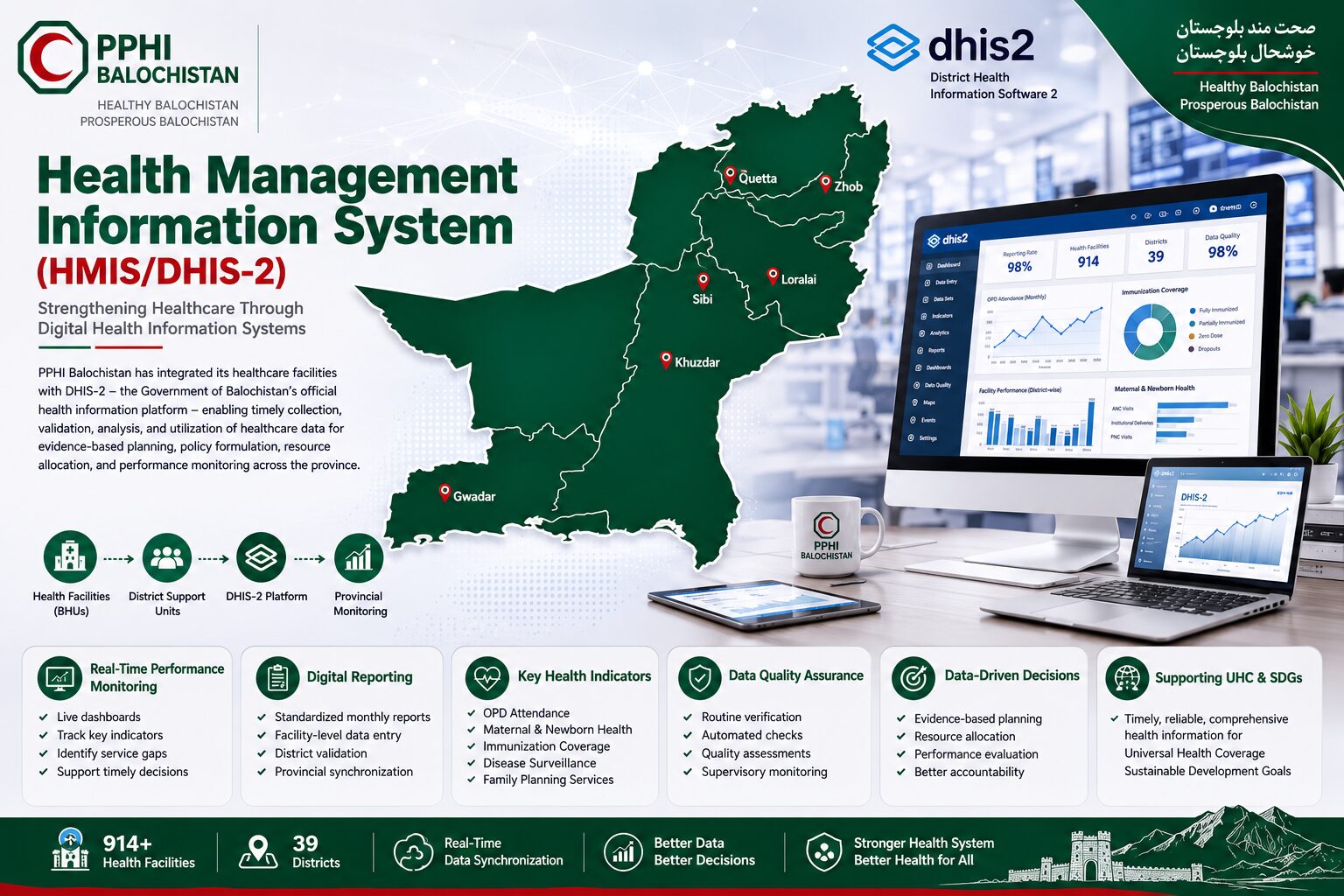
Health Management Information System (HMIS/DHIS-2)
Strengthening Healthcare Through Digital Health Information Systems
PPHI Balochistan has established a robust digital Health Management Information System (HMIS) by integrating its healthcare facilities with the District Health Information Software (DHIS-2), the Government of Balochistan’s official health information platform. This integration enables timely collection, validation, analysis, and utilization of healthcare data to support evidence-based planning, policy formulation, resource allocation, and performance monitoring across the province.
The system serves as the backbone of PPHI-B’s monitoring and evaluation framework, ensuring that health service delivery is continuously tracked through standardized digital reporting mechanisms. By transforming routine health data into actionable information, DHIS-2 has significantly improved transparency, accountability, and decision-making throughout the organization.
Digital Reporting from Health Facilities
Every month, Basic Health Units (BHUs) and other PPHI-managed health facilities submit standardized health service reports covering outpatient services, maternal and child health, immunization, communicable diseases, nutrition, laboratory services, family planning, and other priority health programmes.
District Support Units review and validate facility-level data before uploading it into the centralized DHIS-2 platform. Once synchronized, the information becomes available for real-time monitoring and analysis at the provincial level, allowing managers and programme teams to assess performance, identify service gaps, and initiate timely corrective actions.
This structured reporting mechanism ensures consistency, completeness, and accuracy of health information across all PPHI-managed districts.
DHIS-2 Implementation in Balochistan
The implementation of DHIS-2 has been led by the Provincial Health Information Management System (HIMS)/DHIS Cell under the Health Department, Government of Balochistan, with technical support from development partners including UNICEF Pakistan.
The rollout was undertaken in phases, beginning with priority districts before expanding across the province. Today, DHIS-2 continues to strengthen digital health reporting by providing a unified platform for healthcare facilities, district managers, and provincial health authorities.
Since integrating with the provincial DHIS platform, PPHI Balochistan has standardized reporting across all District Support Units, ensuring that healthcare data generated at BHUs is available within a single provincial information system.
Real-Time Performance Monitoring
The DHIS-2 dashboard provides decision-makers with comprehensive, real-time information on the performance of health facilities across Balochistan. Interactive dashboards support monitoring of key service delivery indicators, including:
- Monthly and daily reporting compliance
- Outpatient Department (OPD) attendance
- Gender and age-wise patient distribution
- Maternal and Newborn Health indicators
- Institutional deliveries
- Immunization coverage
- Family Planning services
- Communicable and non-communicable disease trends
- District-wise health facility performance
- Disease surveillance and epidemiological trends
The availability of live dashboards enables health managers to monitor programme performance continuously and respond rapidly to emerging public health priorities.
Data-Driven Decision Making
Through DHIS-2, PPHI Balochistan has transitioned from conventional paper-based reporting to a modern digital health information ecosystem. Health programme managers and technical teams use routinely generated data to:
- Monitor health service utilization.
- Evaluate programme performance.
- Measure progress against annual targets.
- Identify underperforming facilities.
- Strengthen supervision and supportive monitoring.
- Improve planning and resource allocation.
- Enhance accountability at facility, district, and provincial levels.
This evidence-based approach enables timely interventions and contributes to improved quality of healthcare services throughout the province.
Ensuring Data Quality
Maintaining high-quality health information remains a priority for PPHI Balochistan. Multiple quality assurance mechanisms are embedded within the reporting process, including:
- Routine data verification at facility level.
- District-level validation before submission.
- Automated consistency checks within DHIS-2.
- Regular monitoring by provincial programme teams.
- Periodic data quality assessments and supervisory visits.
These measures ensure that reported information accurately reflects healthcare service delivery and can be confidently used for planning and policy development.
Supporting Universal Health Coverage
The integration of DHIS-2 has strengthened PPHI Balochistan’s capacity to monitor healthcare delivery across hundreds of primary healthcare facilities. By providing timely, reliable, and comprehensive health information, the system supports the Government of Balochistan’s commitment to Universal Health Coverage (UHC) and Sustainable Development Goals (SDGs).
The digital platform enables continuous monitoring of healthcare services, improves coordination among stakeholders, and promotes evidence-based health system strengthening across the province.
Driving Digital Transformation in Healthcare
PPHI Balochistan continues to invest in digital innovation to enhance healthcare governance and service delivery. The adoption of DHIS-2 has transformed routine health reporting into a dynamic information management system that supports strategic planning, operational efficiency, and continuous quality improvement.
By leveraging digital technologies and real-time analytics, PPHI-B is building a stronger, more responsive, and data-driven primary healthcare system capable of meeting the evolving healthcare needs of the people of Balochistan.
In the following years, the government began contracting out the management and execution of primary health services to the People’s Primary Healthcare Initiative (PPHI). The 18th Constitutional amendment enhanced provincial autonomy by transferring, among other things, the subject of health to the provinces. Having the health sector in its purview and considering PPHI’s previous performance, the Government of Balochistan decided to renew the agreement with PPHI-B for delivery of primary healthcare services. So far, over 913 Basic Health Units and Health Facilities BHUs/HFs across thirty-three districts of Balochistan have been taken over by PPHI-B under the renewed agreement. PPHI Balochistan now operates as a not-for-profit registered company with an eminent Board of Directors.
Public-private partnerships are increasingly seen as playing a critical role in improving the performance of health systems worldwide, by bringing together the best characteristics of the public and private sectors to improve efficiency, quality, innovation, and health impact of both private and public systems. Yet, we also know that while partnerships can be an effective force toward achieving these results, they are not a magic solution to the many problems that now faced by health systems in Balochistan and countrywide. If partnerships are to be effective in addressing the issues of poverty reduction and equity, quality improvement, and cost containment, considerable work will need to be done to develop the accountability and transparency, the legal and regulatory framework, and the mutual trust that is necessary for partnerships to succeed.