
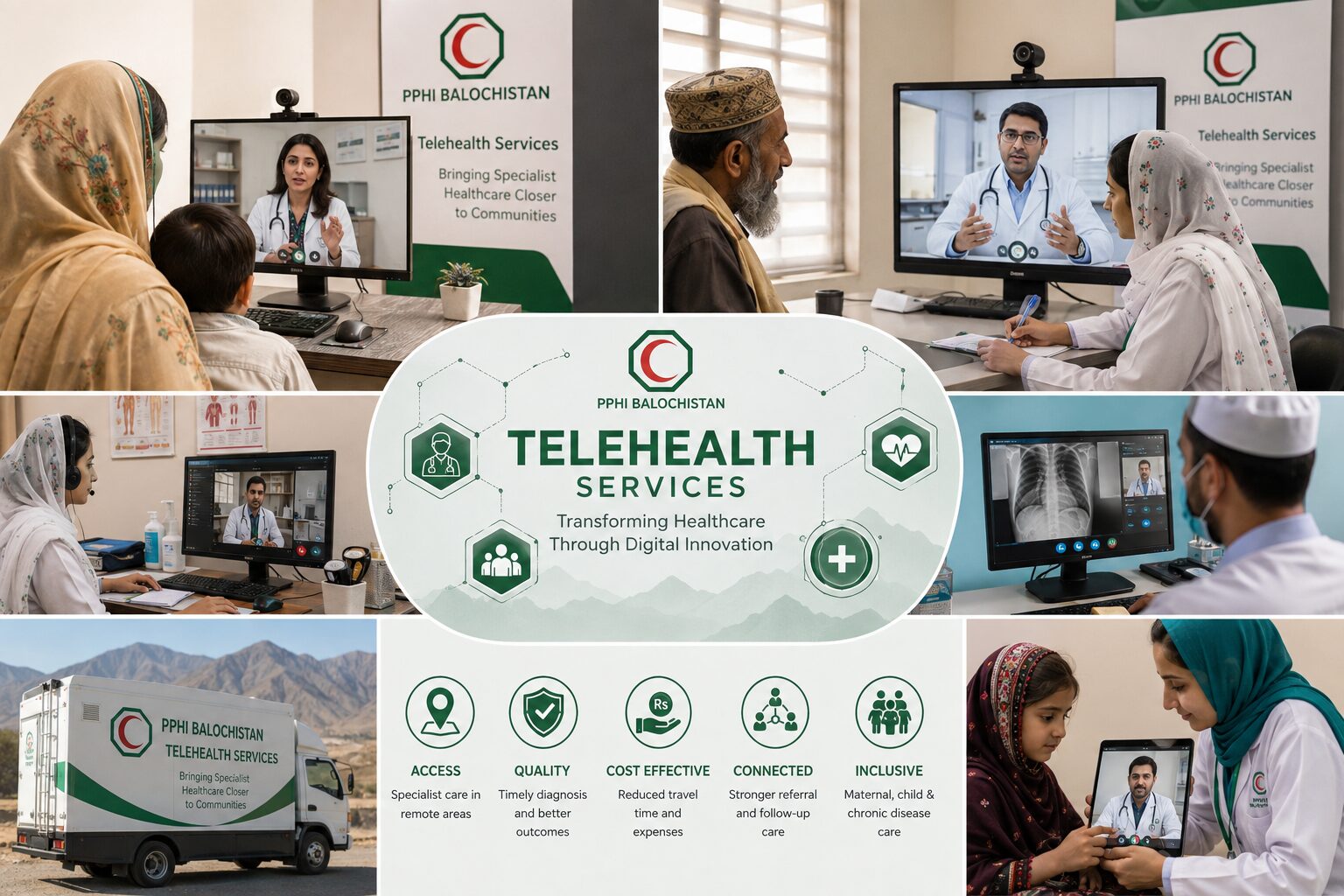
Telehealth Services
Transforming Healthcare Through Digital Innovation
PPHI Balochistan is revolutionizing healthcare delivery by leveraging telehealth technology to connect patients in remote and underserved communities with qualified medical specialists across the province. The Telehealth Program bridges geographical barriers by enabling patients to receive timely specialist consultations without the need to travel long distances, thereby improving access to quality healthcare while reducing financial and logistical burdens.
The initiative forms an integral part of PPHI-B’s commitment to strengthening primary healthcare services through innovation, ensuring equitable access to specialized medical care for populations living in hard-to-reach areas of Balochistan.
Bringing Specialists Closer to Communities
Through a robust telehealth network, patients visiting PPHI-managed Basic Health Units (BHUs) and healthcare facilities are connected in real time with experienced medical specialists using secure digital consultation platforms. Local healthcare providers facilitate consultations, ensuring that patients receive comprehensive clinical assessments, appropriate treatment plans, follow-up care, and referrals whenever advanced medical intervention is required.
This model enables patients to access specialist healthcare within their own communities, significantly reducing travel time, treatment delays, and out-of-pocket expenses.
Comprehensive Specialist Consultations
The Telehealth Program provides access to a broad range of specialist services, including:
- Obstetrics & Gynecology
- Cardiology
- Gastroenterology
- Nephrology
- Urology
- Ear, Nose & Throat (ENT)
- Dermatology
- Ophthalmology
- Pulmonology
- Endocrinology
- Rheumatology
- Nutrition and Dietetics
- General Specialist Consultations
The availability of multiple specialties through a single digital platform ensures that patients receive timely, coordinated, and high-quality healthcare regardless of their geographic location.
Expanding Reach Across Balochistan
Telehealth services are currently operational across multiple districts of Balochistan, extending specialist healthcare to communities where access to secondary and tertiary healthcare facilities is limited. By integrating telemedicine into primary healthcare services, PPHI-B has strengthened the referral system and improved continuity of patient care throughout the province.
The program continues to expand, enabling more healthcare facilities and communities to benefit from digital healthcare solutions.
Increasing Community Trust and Service Utilization
Telehealth service utilization has shown consistent growth over recent years, reflecting increased community awareness, greater confidence in digital healthcare, and the successful integration of telemedicine into routine healthcare delivery.
Patient consultations have steadily increased, with significant growth observed during recent years as more healthcare facilities became connected to the telehealth network. Women constitute the largest proportion of beneficiaries, demonstrating the program’s strong contribution to improving maternal and reproductive healthcare. At the same time, consultations for children and male patients have also continued to rise, highlighting the expanding acceptance and effectiveness of telehealth services across all population groups.
This sustained increase reflects PPHI-B’s ongoing efforts to improve healthcare accessibility, strengthen digital infrastructure, and ensure the availability of specialist medical expertise throughout the province.
Improving Quality of Care
The Telehealth Program enables early diagnosis, prompt clinical decision-making, effective disease management, and timely referrals for patients requiring advanced treatment. Through continuous collaboration between on-site healthcare providers and remote specialists, patients receive comprehensive and evidence-based care while remaining within their local communities.
This integrated approach enhances healthcare quality, improves patient outcomes, and supports more efficient utilization of healthcare resources.
Key Benefits of the Telehealth Program
- Improved access to specialist healthcare in remote and underserved areas.
- Reduced travel time and healthcare-related expenses for patients.
- Faster diagnosis and timely clinical decision-making.
- Strengthened referral pathways to higher-level healthcare facilities.
- Enhanced continuity of care through regular follow-up consultations.
- Increased access to maternal, child, and chronic disease management services.
- Better utilization of specialist expertise through digital connectivity.
- Improved equity in healthcare service delivery across Balochistan.
Driving the Future of Digital Healthcare
PPHI Balochistan continues to strengthen its Telehealth Program through investments in digital infrastructure, specialist networks, healthcare workforce capacity, and innovative service delivery models. By integrating technology with primary healthcare, the organization is creating a more accessible, efficient, and patient-centered healthcare system.
The continued growth in telehealth consultations demonstrates the increasing confidence of communities in digital healthcare services and reinforces PPHI-B’s commitment to ensuring that quality specialist care is available to every citizen, regardless of distance or location.
In the following years, the government began contracting out the management and execution of primary health services to the People’s Primary Healthcare Initiative (PPHI). The 18th Constitutional amendment enhanced provincial autonomy by transferring, among other things, the subject of health to the provinces. Having the health sector in its purview and considering PPHI’s previous performance, the Government of Balochistan decided to renew the agreement with PPHI-B for delivery of primary healthcare services. So far, over 913 Basic Health Units and Health Facilities BHUs/HFs across thirty-three districts of Balochistan have been taken over by PPHI-B under the renewed agreement. PPHI Balochistan now operates as a not-for-profit registered company with an eminent Board of Directors.
Public-private partnerships are increasingly seen as playing a critical role in improving the performance of health systems worldwide, by bringing together the best characteristics of the public and private sectors to improve efficiency, quality, innovation, and health impact of both private and public systems. Yet, we also know that while partnerships can be an effective force toward achieving these results, they are not a magic solution to the many problems that now faced by health systems in Balochistan and countrywide. If partnerships are to be effective in addressing the issues of poverty reduction and equity, quality improvement, and cost containment, considerable work will need to be done to develop the accountability and transparency, the legal and regulatory framework, and the mutual trust that is necessary for partnerships to succeed.